Waarom biedt CNC-technologie gitaarbouwers een concurrentievoordeel?
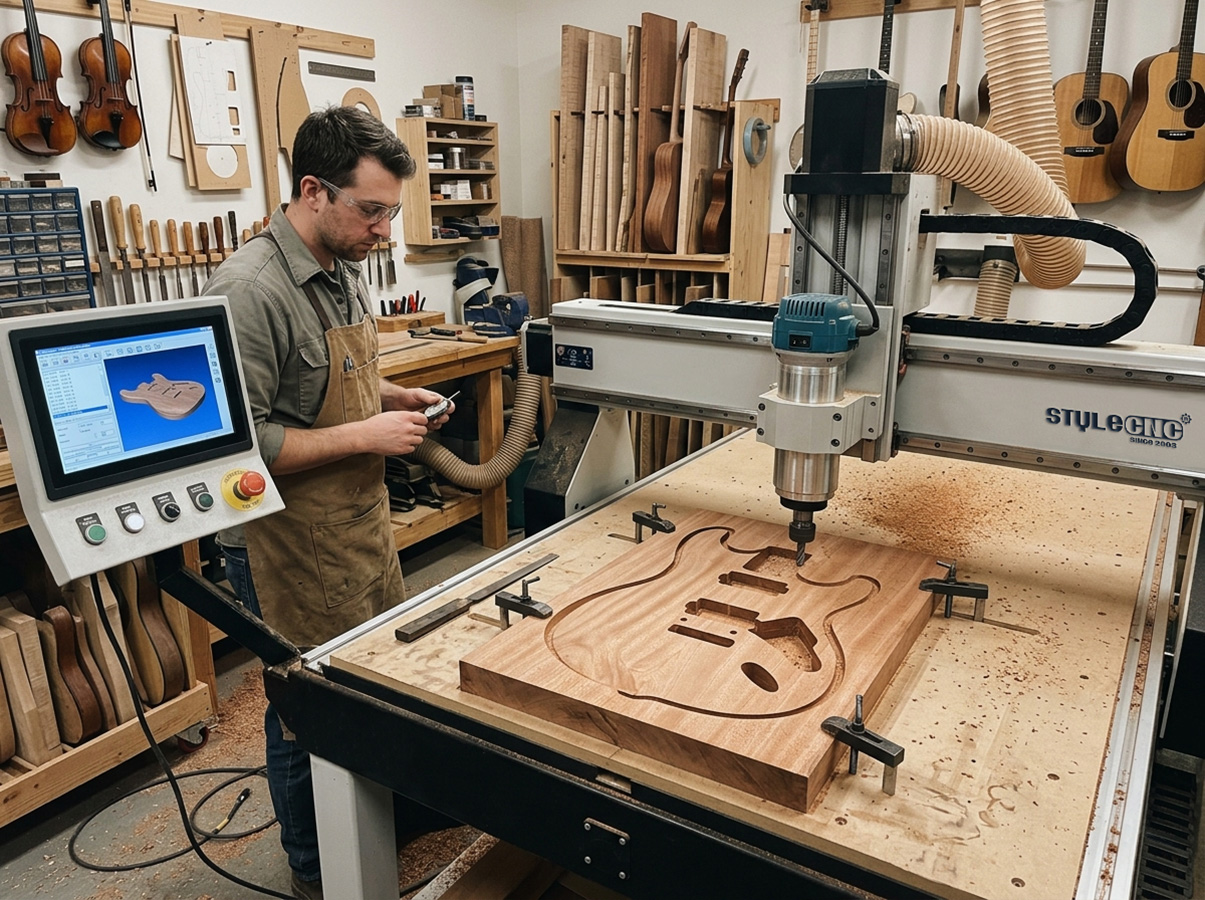
Traditionele gitaarbouw vergt honderden uren per instrument. De productie van één enkele hals voor een akoestische gitaar, met de hand gesneden en gevormd, kan wel drie volle dagen in beslag nemen. Met een CNC houten routerDiezelfde hals wordt in minder dan 4 uur gefreesd, inclusief de insteltijd. Dit snelheidsvoordeel wordt versterkt bij serieproductie, waardoor kleine werkplaatsen tegelijkertijd maatwerk kunnen leveren en voorraad kunnen produceren.
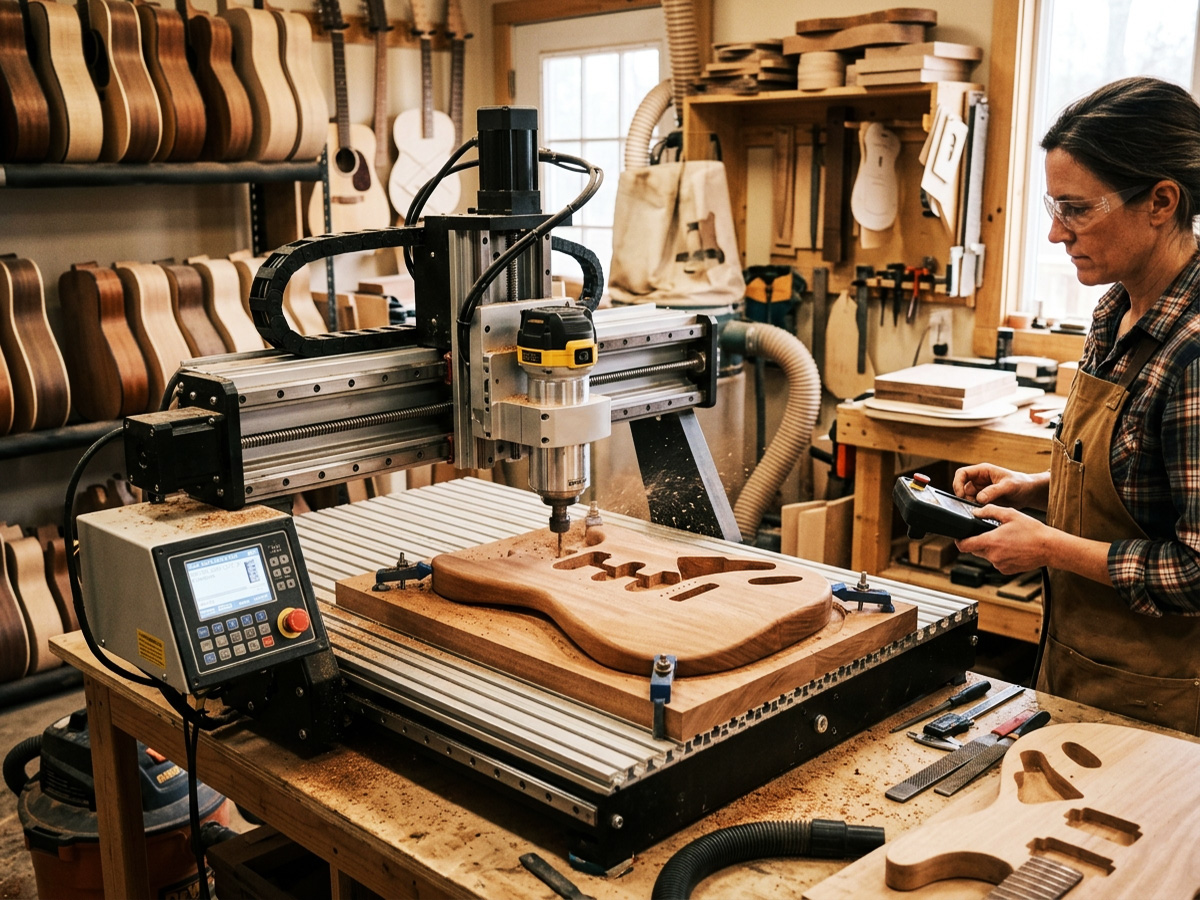
CNC-frezen elimineert ook de inconsistentie die handgemaakte instrumenten kenmerkt. Elke holte, radius en contour wordt gerepliceerd aan de hand van geverifieerde CAD-bestanden, waardoor de tiende gitaar die van de productielijn rolt identiek klinkt en speelt aan de eerste.
| maat | Met de hand gebouwd | CNC-gefreesd |
|---|---|---|
| Tijd voor lichaamsvorming | 6-8 uur | 45-90 minuten |
| Tijd voor het snijden van de hals | 2 – 3 dagen | 3-4 uur |
| dimensionale tolerantie: | ±0.5 mm typisch | ±0.05 mm haalbaar |
| Materiaalafvalpercentage | 15-25% | 5-10% |
| Batchconsistentie | Veranderlijk | Identiek per CAD-bestand |
Toenemende vraag naar CNC-gefreesde gitaaronderdelen
De wereldwijde gitaarmarkt had in 2025 een waarde van ongeveer 12.7 miljard dollar en zal naar verwachting tot begin dit jaar groeien met een samengesteld jaarlijks groeipercentage van circa 7.5%. 2030Maatwerk- en boutique-instrumenten vormen een van de snelstgroeiende segmenten, waarbij de orderaantallen bij custom shops ongekende hoogten bereiken.
Online marktplaatsen zoals Reverb, Etsy en eBay hebben het voor kleine gitaarbouwers opmerkelijk eenvoudig gemaakt om kopers over de hele wereld te bereiken. Alleen al de verkoop van gebruikte en boutique gitaren vertegenwoordigt een jaarlijkse markt van meerdere miljarden dollars, die met meer dan 5% per jaar.
• Ongeveer 45-49% van de nieuwe gitaristen sinds 2020 is vrouw, waardoor het kopersbestand aanzienlijk is uitgebreid.
• Instapgitaren onder $200 rekening houdend met ongeveer 60% De verkoop van deze onderdelen zorgt voor een enorme vraag naar betaalbare, goed gemaakte componenten.
• Online gitaarverkopen vertegenwoordigen nu 38%.40% van alle Amerikaanse gitaaraankopen
• De vraag naar maatwerk is enorm toegenomen, waarbij kopers op zoek zijn naar gepersonaliseerde carrosserievormen, inlays en afwerkingen.
Wat je kunt maken en verkopen: een productcatalogus met prijsinformatie?
Een CNC-gitaarbouwbedrijf beperkt zich niet tot complete instrumenten. De verkoop van onderdelen, accessoires en aanvullende producten biedt meerdere inkomstenstromen. Hieronder vindt u een productcatalogus met een indicatie van de prijs per stuk voor CNC-geproduceerde artikelen.
| Product | Materiaal | Prijsklasse | Verkoop kanaal |
|---|---|---|---|
| Gitaarbody voor elektrische gitaar (blank) | Els, Es, Linde | $ 60- $ 150 | Reverb, eBay, directe bestellingen |
| Akoestische gitaar body kit | Sparrenhout, mahoniehout | $ 120- $ 300 | Leveranciers van benodigdheden voor gitaarbouwers |
| Gitaarhals (esdoorn/palissander) | Esdoorn, Mahonie | $ 50- $ 180 | Reverb, Etsy, groothandel |
| Toets / toetsenbord | Ebbenhout, palissander, esdoorn | $ 20- $ 60 | Levering door gitaarbouwers, rechtstreeks. |
| kopbekleding / fineer | Ebbenhout, exotische hardhoutsoorten | $ 8- $ 25 | Etsy, forums voor gitaarbouwers |
| Aangepaste inlays (toets/rozet) | Parelmoer, abalone, acryl | $ 15- $ 80 | Direct, Reverb, Etsy |
| Slagplaten | Acryl, hout, celluloid | $ 10- $ 40 | Amazon, Reverb, direct |
| Gitaarpickjes (met eigen logo) | Acryl, hout, hoorn | $ 2–$ 8 per stuk | Etsy, bandmerchandise, groothandel |
| Gitaarstandaards / muurbeugels | Hardhout, Multiplex | $ 25- $ 75 | Amazon, Etsy, muziekwinkels |
| Inzetstukken op maat voor gitaarkoffers | Schuim + multiplex schaal | $ 40- $ 120 | Direct, nagalm |
| Mallen en sjablonen voor bouwers | MDF, Acryl | $ 15- $ 50 | Forums voor gitaarbouwers, Etsy |
De juiste CNC-frees kiezen voor gitaarbouw
De juiste machine kiezen hangt af van uw productievolume, werkruimte en budget. Een compacte freesmachine van 600 x 900 mm is geschikt voor het bewerken van individuele gitaarbody's en -halzen, terwijl een freesmachine van normaal formaat minder geschikt is. 4x8 CNC houten router Hiermee kunt u meerdere onderdelen op één vel plaatsen, waardoor de doorvoer bij serieproductie wordt gemaximaliseerd.
Voor werkplaatsen die verschillende profielen snijden (holtes in de klankkast, halsuitsparingen, inleguitsparingen), een ATC CNC-freesmachine met automatische gereedschapswisselaar Het elimineert handmatige bitwisselingen en bespaart aanzienlijk tijd bij meerdere bewerkingen. Een spindel van 2.2–3.0 kW levert voldoende vermogen voor hardhoutsoorten zoals esdoorn en mahonie. Voor grotere commerciële toepassingen biedt een spindel van 4.5 kW of meer in combinatie met vacuümklemkracht prestaties van industriële kwaliteit.
Aanbevolen machineconfiguraties
| Scale | Werkgebied | Spindel | beste voor |
|---|---|---|---|
| Hobby / Start-up | 600 × 900 mm | 1.5–2.2 kW | Productie van één body/hals, prototyping |
| Kleine werkplaats | 1300 × 2500 mm | 3.0–4.5 kW | Serieproductie, genest snijden, mallen maken |
| Productie Winkel | 1500 × 3000 mm+ | 4.5–9.0 kW + ATC | Productie op grote schaal, nesten van meerdere onderdelen |
Materiaalaanbevelingen voor CNC-gitaaronderdelen
De keuze van het klankhout heeft direct invloed op de geluidskwaliteit, de bewerkbaarheid en de verkoopwaarde. Hieronder staan de meest gebruikte materialen bij de CNC-gitaarproductie, samen met hun typische toepassingen.
• Elzenhout / Lindehout: Lichtgewicht, gemakkelijk te bewerken, uitstekend geschikt voor gitaarbody's van elektrische gitaren. Geliefd bij bouwers van Fender-achtige modellen.
• Essen (moerasessenhout): Open nerf, heldere klank. Populair voor Telecaster- en Stratocaster-achtige gitaren.
• Mahonie: Warme, rijke klank met uitstekende sustain. Standaard voor Les Paul-achtige body's en achter-/zijkanten van akoestische gitaren.
• Esdoorn: Dicht en helder van kleur. Gebruikt voor halzen, toetsen en bovenbladen van body's. Vereist scherp gereedschap en lagere aanvoersnelheden bij CNC-bewerking.
• Sparrenhout: Het meest gebruikte hout voor het klankbord van akoestische gitaren. Licht, stijf en resonant.
• Ebbenhout / Palissander: Premium toetshoutsoorten. Dicht en olierijk, gebruik hardmetalen gereedschappen en lagere spindelsnelheden.
Waarde toevoegen met lasergraveren en inlegwerk
Inlays op de toets, rozetten en logo's op de kop zijn waardevolle toevoegingen die custom gitaren onderscheiden van massaal geproduceerde instrumenten. Een CNC-freesmachine verzorgt het frezen van uitsparingen voor inlays van schelp en acryl, terwijl een lasergravure machine Hiermee kunnen gedetailleerde decoratieve gravures, serienummers en merklogo's rechtstreeks op houten, benen of acryloppervlakken worden aangebracht.
Een combineren Cnc router Met een laserexpander kunt u in uw werkplaats volledig op maat gemaakte instrumenten aanbieden tegen premium prijzen. Veel succesvolle gitaarbouwers melden dat alleen al de diensten voor inlegwerk en graveren op maat 20% van de omzet genereren.30% van de totale omzet.
Bedrijfsrendement: analyse van investering versus rendement
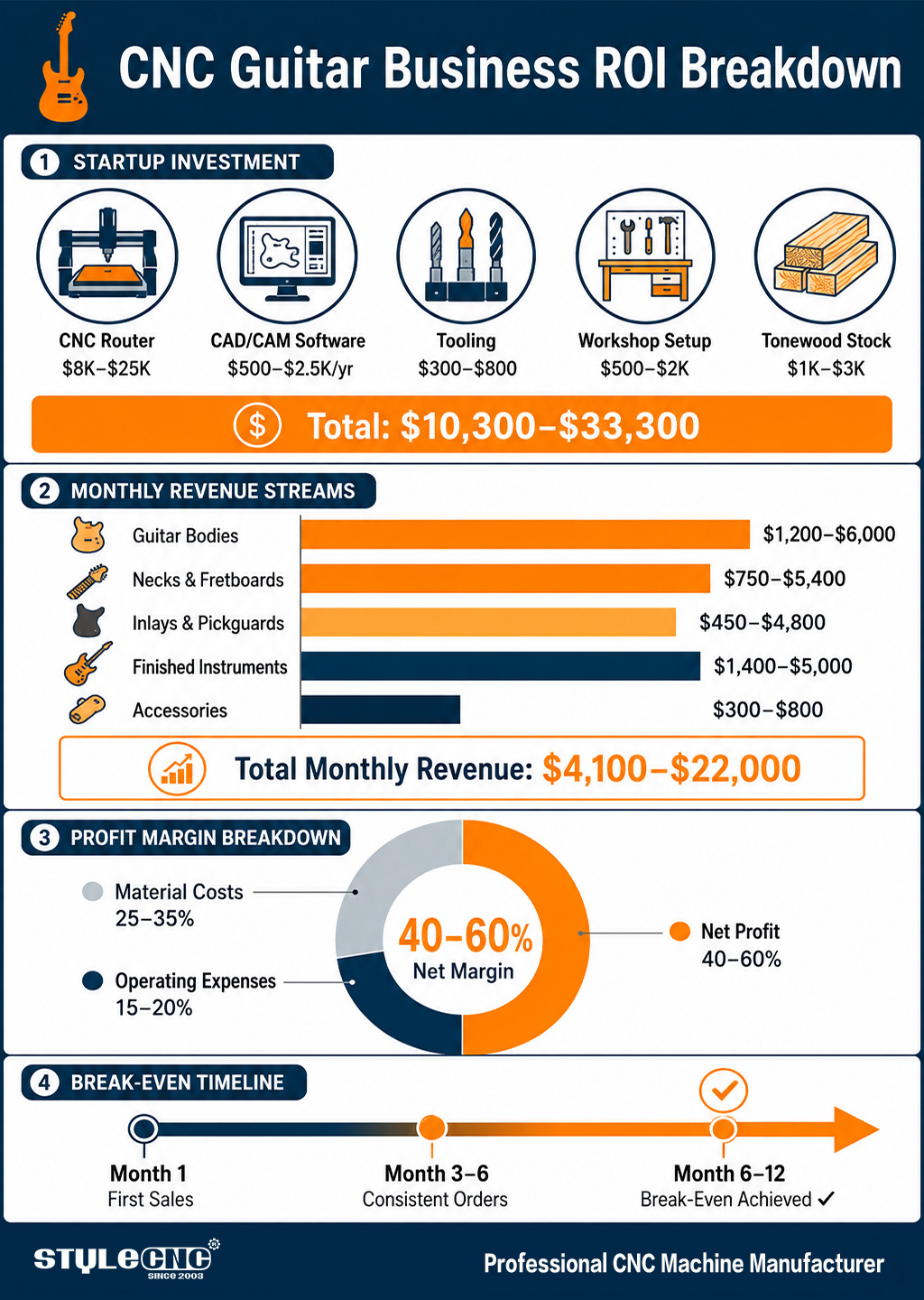
Inzicht in de financiële situatie is essentieel voordat je van start gaat. Hier is een realistische ROI-prognose gebaseerd op een kleine werkplaats die CNC-gitaaronderdelen en afgewerkte instrumenten produceert.
| Investeringsitem | Geschatte kosten |
|---|---|
| CNC-frees (3-assig, automatische gereedschapswisselaar, 1300×2500 mm) | $ 8,000- $ 25,000 |
| CAD/CAM-software (Fusion 360, VCarve, enz.) | $500–$2,500/jaar |
| Gereedschap (vingerfrezen, kogelkopfrezen, V-frezen) | $ 300- $ 800 |
| Stofafzuiging en werkplaatsinrichting | $ 500- $ 2,000 |
| Initiële voorraad klankhout | $ 1,000- $ 3,000 |
| Totale opstartinvestering | $ 10,300- $ 33,300 |
Maandelijkse omzetprognose (kleine werkplaats)
| Inkomstenstroom | Eenheden / Maand | maandelijkse omzet |
|---|---|---|
| Gitaarbody's (elektrisch) | 20-40 | $ 1,200- $ 6,000 |
| Halzen en toetsen | 15-30 | $ 750- $ 5,400 |
| Inlays en slagplaten op maat | 30-60 | $ 450- $ 4,800 |
| Voltooide instrumenten | 2-5 | $ 1,400- $ 5,000 |
| Accessoires (plectrums, standaards, mallen) | 50–100 + | $ 300- $ 800 |
| Totale geschatte maandelijkse omzet | - | $ 4,100- $ 22,000 |
Met materiaalkosten die gemiddeld 25-35% van de omzet bedragen en operationele kosten rond de 15-20%, nettowinstmarges van 40–60% Dit is haalbaar voor goed geleide CNC-gitaarbedrijven. De meeste werkplaatsen bereiken het break-evenpunt binnen 6-12 maanden bij een constante productie.
Hoe bereik je je kopers?
De verkoop van CNC-gefreesde gitaaronderdelen en -instrumenten vereist een multichannel-aanpak. Hieronder vind je de meest effectieve strategieën die gitaarbouwers gebruiken om klanten te vinden en te behouden.
✓ Reverb.com – De grootste gespecialiseerde marktplaats voor muziekinstrumenten en -onderdelen. Lage plaatsingskosten, ingebouwd kopersvertrouwen en sterke SEO voor gitaaronderdelen.
✓ Etsy – Ideaal voor op maat gemaakte inlays, plectrums met logo, unieke kopversieringen en handgemaakte accessoires.
✓ eBay / Amazon – Grote volumes voor gestandaardiseerde body's, halzen en hardwarekits.
✓ Directe website met Shopify – Bouw je merk op, presenteer maatwerkproducten en behaal hogere marges door rechtstreeks aan de consument te verkopen.
✓ Muziekwinkels en -distributeurs – Groothandelspartnerschappen voor winkels en ketens.
✓ Community's voor gitaarbouwers – Forums zoals LMI, de StewMac-community en sociale mediagroepen brengen je in contact met professionele bouwers die betrouwbare leveranciers van onderdelen nodig hebben.
Veel voorkomende fouten te vermijden
Het opzetten van een CNC-gitaarbedrijf vergt de nodige leerervaring. Dit zijn de valkuilen waar de meeste nieuwe gitaarbouwers in trappen:
• Prototypen overslaan: Test altijd eerst met goedkoop populierenhout of MDF voordat u begint met het bewerken van hoogwaardige klankhoutsoorten.
• Onjuiste aanvoersnelheden voor hardhout: Dichte houtsoorten zoals esdoorn en ebbenhout vereisen lagere aanvoersnelheden en scherpe hardmetalen gereedschappen om splintering te voorkomen.
• Stofafzuiging negeren: Fijn houtstof beschadigt de spindellagers en -geleiders. Investeer vanaf dag één in een goede afzuiginstallatie.
• Geen kwaliteitscontroleproces: Elke batch wordt met een schuifmaat opgemeten. Zelfs een afwijking van 0.2 mm in de halsbevestiging beïnvloedt de bespeelbaarheid.
• Je werk te laag prijzen: Houd rekening met machinetijd, materiaal, afwerking, verzending en platformkosten voordat je prijzen vaststelt.
• Te veel vertrouwen op CNC alleen: Het uiteindelijke schuren, het frezen, de afwerking en de afstelling blijven handmatige processen. CNC wordt gebruikt voor de grove en precieze vormgeving, niet voor de volledige constructie.
Aan de slag: stapsgewijze checklist
Volg deze stappen om zo snel mogelijk van idee naar eerste verkoop te komen.
1. Onderzoek je niche: elektrische gitaarbody's, akoestische bouwpakketten, accessoires, of alle drie.
2. Selecteer en bestel uw CNC-router. Bekijk de opties van de STYLECNC catalogus van CNC-houtfreesmachines om aan te sluiten bij uw budget en productiedoelen.
3. Installeer CAD/CAM-software (Fusion 360, VCarve Pro of Aspire) en leer de gereedschapspaden die specifiek voor gitaren zijn ontworpen.
4. Betrek klankhout bij gerenommeerde leveranciers (Gilmer Wood, Cook Woods of lokale zagerijen voor hergebruikt hout).
5. Maak eerst prototypes van je ontwerpen in MDF of populierenhout voordat je kiest voor hoogwaardige basismaterialen.
6. Maak verkopersaccounts aan op Reverb, Etsy en je eigen Shopify-winkel.
7. Fotografeer en vermeld uw producten met gedetailleerde specificaties, houtsoort en claims over CNC-precisie.
8. Bouw een aanwezigheid op sociale media (Instagram, YouTube, TikTok) op door video's te delen van je CNC-productieproces. Deze video's converteren namelijk erg goed.
Bekijk: CNC-freesmachine maakt een gitaarbody
Zie een STYLECNC Een freesmachine in actie, die een gitaarbody vormgeeft uit een onbewerkt stuk hout. Bekijk de volledige videodemonstratie: CNC-router voor het zelf maken van een gitaarbody.
Veelgestelde Vragen / FAQ
Welke maat CNC-freesmachine heb ik nodig om gitaren te maken?
Een werkoppervlak van minimaal 600 × 900 mm is geschikt voor individuele carrosserieën en halzen. Voor serieproductie en het nesten van plaatmateriaal wordt een tafel van 1300 × 2500 mm of groter aanbevolen.
Wat zijn de kosten om een bedrijf te starten dat gitaren maakt met behulp van CNC-machines?
Instapmodellen beginnen rond $1$0,000–$15,000, inclusief de router, software, gereedschap en beginmaterialen. Werkplaatsen van productieniveau vereisen doorgaans... $20,000–$35,000.
Kan ik CNC-bewerking ook gebruiken voor akoestische gitaren, en niet alleen voor elektrische gitaren?
Ja. CNC-freesmachines bewerken de verstevigingen, halsblokken, rozetten, brugplaten en bodyvormen voor akoestische gitaren. Veel gitaarbouwers gebruiken CNC voor alle structurele onderdelen en reserveren handwerk voor het intoneren en de uiteindelijke assemblage.
Welke CAD/CAM-software is het meest geschikt voor het bouwen van gitaren?
Fusion 360, VCarve Pro en Aspire zijn de populairste programma's onder gitaarbouwers. Gratis opties zoals FreeCAD werken prima voor eenvoudige 2D-profielen, maar 3D Voor het uitsnijden van een hals met behulp van grafische tools is doorgaans Fusion 360 of MeshCAM nodig.
Is het bouwen van gitaren met CNC-machines een winstgevende bijverdienste?
Absoluut. Door slechts 10-20 gitaarbody's en -halzen per maand te verkopen op Reverb of Etsy kun je al een flink bedrag verdienen. $1$500–$4,000 aan omzet met 40–60% De marges maken het een haalbare bijverdienste naast een vaste baan.
Vervangt CNC-bewerking handwerk bij het maken van gitaren?
Nee. CNC-machines verzorgen precisievormen, het frezen van holtes en repetitieve taken. Het uiteindelijke schuren, het frettenwerk, de afwerking, de afstelling en de kwaliteitscontrole blijven essentiële handvaardigheden die de reputatie van een bouwer bepalen.